Philosopher Anna Greenspan’s PhD dissertation, Capitalism’s Transcendental Time Machine (2000), like the early work of her associate Nick Land, has recently experienced a significant revival of attention. Concerns about the direction that our world is taking have beset a new generation of thinkers, both in the philosophical mainstream and the alternative realm. As a result, certain strange and wonderful writings of the 1990s are attracting renewed interest.
The core proposal of Greenspan’s work is striking: that it is Capitalism which has manufactured the framework of linear time—a system we use to navigate our days—so as to enslave us to its cause. Since Kant’s original hypothesis regarding linear time and the transcendent in the late eighteenth century, it is undeniable that we have become increasingly bound to temporal structures. We wear watches, hang clocks on our walls, and carry smartphones showing the time. Time dictates when we wake, work, and rest. Unless one lives on an uninhabited island, there’s virtually no possibility of escaping time. But is time solely a human creation?
Beneath such speculations lies a deeper question: is the ever-expanding reach of global capitalism—drawing more of the world’s resources and people into its grasp each year—purely a human phenomenon, or rather the result of extra-dimensional activity? Might some xeno-entity have hurled a spiralling positive feedback loop into human culture and now be sitting back observing, as it sucks ever more of our world into its clutches?
A decade or two ago, such a suggestion would have seemed ludicrous and found itself buried in the darkest reaches of Reddit. Yet, as the world continues to change, and as our lack of control over capitalism becomes glaringly clear, these once-outlandish theories are becoming worthy of consideration.
I have been drawn into this domain of speculative futurism over the last few years and find it fascinating. One thing becomes apparent: we understand remarkably little about our world. While science has delivered remarkable tools and technology, it cannot peer beneath the surface of human existence. Each year brings less certainty about the mysteries of consciousness or matter, leading even the most dedicated scientists to admit their ignorance.
As a society, we continue to venerate science. But even its most faithful practitioners are now beset by doubts. Many of us cling to science because the alternative—admitting near-total ignorance—is deeply unsettling. We reassure ourselves with images of big, expensive machines and professionals in lab coats, but the truth is that, fundamentally, they do not know what is really going on.

And so: xeno-causation. To what extent could outside forces be running our world? Could it be that capitalism is not our creation after all? For those concerned about where things might be heading, isn’t it valid to explore other possibilities? I say, hell yeah, it absolutely is. It’s a dirty job, but one that a few brave, or arguably mad, souls need to undertake.
Personally, as a non-Muslim living in a Muslim country and studying Greenspan’s theory, something jumps out at me: if capitalism is a transcendental time machine, then surely Islam—the world’s fastest-growing religion—is one too. Capitalism gives us clocks and alarms to regulate work and leisure. Islam gives its followers five daily calls to prayer.
Islam punctuates each 24-hour period at five points, aligned not with the mechanical clock (as with capitalism) but with the sun’s position relative to the horizon: first light, zenith, mid-shadow, sunset, and nightfall. Its two billion devotees worldwide operate as a kind of global clock, synchronized not with the linear ticking of time, but with the movement of the sun. The times of the adhan—the call to prayer—depend on your physical location, not on the clock on your wall.
When we consider both capitalism and Islam as higher-dimensional machines constraining and directing libidinal energy, it’s clear that they are neither in strict opposition nor in alignment. Capitalism binds human energy to an abstract, decimal system of linear time. Islam binds it to a nonlinear structure based on the movements of the sun—in a sense riveting a five-pointed shape into higher-dimensional space. This shape is constraining the linear cultural progress effected via capitalism. It may well be the only thing that actively is.
Islam stands out to me not only because of the adhan, but also due to its remarkable success—especially considering the devotion it demands. It’s really not like say Protestantism—a religion created to interfere as little as possible with the market. In fact, Islam has resisted the encroachments of capitalism more effectively than any other religion. Its numbers continue to rise, and it is poised to soon overtake all the world’s other religions. That fact deserves reflection.
Furthermore, all the strategies the West has devised to contain or oppose capitalism—Marxism, environmentalism, and more—have largely failed. Capitalism finds ways around them. Yet Islam continues undeterred. Could it one day actively challenge capitalism for global hegemony—dominion over the world’s libidinal economy?
Of all who oppose capitalism, Muslims are among the most fervent and resistant to its world order. Is this because their bodies are actually bound to the trajectory of a different xeno-agent, rather than merely going through a ‘phase of rebellion’ like many Western dissidents?
Western resistance to capitalism usually arises from those marginalized by its hierarchy. Feeling wronged, they protest—carrying banners, boycotting, marching. Yet this opposition, on a psychological level, enmeshes them with that which they resist. Their sense of self becomes defined by the struggle against capitalism, binding them to it as surely as any office worker.
The Muslim, however, is differently positioned. His struggle is not defined by capitalism; rather, he follows the tenets and rituals of his faith. Consider, for illustrative purposes, the typical Western male and the typical Muslim male.
The Westerner treasures his sense of agency and free will. He works, enjoys leisure, values his ideals, and engages only minimally in conscious ritual. What he believes in is immensely important to him. Growing up in a culture fixated on linear time and progress, he may become despairing and collapse if things aren’t moving ‘forward.’ He supports causes online, believing that changing minds will change the world. Yet, despite such efforts, he remains utterly dependent on capitalism, actually incapable of altering its direction and ever at its mercy.
The Muslim, on the other hand, must surrender much of his agency to Islam. He must commit himself to five rounds of daily prayers. His life and libidinal energy are bound to the sun’s cycle. Immersed in cyclical rather than linear time, his need for progress is less.
Could the conscious surrender of agency to ritual be essential for achieving or maintaining power—meaning that belief itself is less important than submission? Historically, this was the case for Europe’s ruling classes. Queen Elizabeth II, as a standard bearer for whole echelons of embedded social and political structure, famously had almost no days off; ceremonial duty was essential to maintaining power structures. Willingness to conform to ritual was vital to consolidating power.
Perhaps this surrender of personal agency into a higher-dimensional vessel—through regular ritual—creates a carrier that can elevate certain ideas to hegemony.
Before I close, I want to mention an important figure: known in Arabic as Jibreel. In English or Hebrew he is called Gabriel, as in the archangel Gabriel. According to Muslim tradition, Gabriel delivered the Quran—the core document of Islam—to the Prophet Muhammad in the seventh century. Islam, in this sense, is Gabriel’s creation. Let’s take a look at the generally understood role of Gabriel in esotericism, via Tarot Key 20 – Judgement.
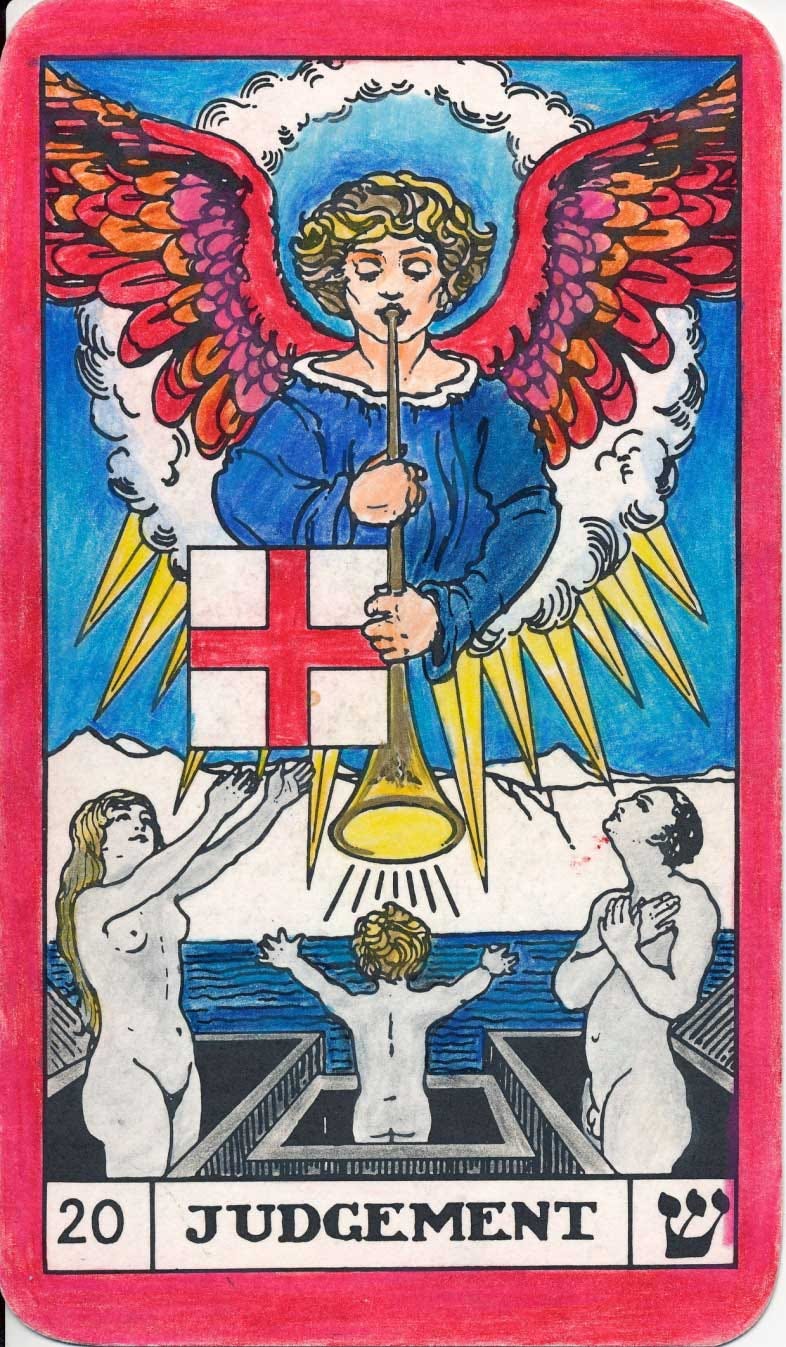
This card, from the Hermetic mystical tradition, depicts Gabriel blowing a horn to awaken a man, woman, and child from their coffins—symbols of three-dimensional, time-bound reality. Icy peaks in the background represent the mathematical structures that esotericists believe undergird physical reality. ‘Judgement’ suggests a transition after a period of deliberation. Thus Gabriel is here awakening people from linear time. It’s an evocative parallel.
So what are we really looking at here? What is being worked out? Were global capitalism and Islam both originally the work of xeno-agents, now long since decamped? Might the second half of our century be dominated by a fight between these two heavyweights for global dominion? And do we have options, other than ideology-based strategies, if neither of these two appeals?
To conclude: I’d like to be clear that I am personally agnostic about Islam. I am neither a follower nor a believer, and have no intent to convert anyone—neither to Islam nor to capitalism. My interest here is in xeno-causation as a theoretical framework, and that is the speculative spirit in which this piece is written.
The author’s novel Lemurian Pushback, written in his characteristic page-turner style, may be downloaded for free here.