Lift your eyes on high and see: Who created these? – Isaiah 40:26
This line from the book of Isaiah, in the Hebrew Bible (Tanakh), famously points to the true pathway to spiritual knowledge. The crux of it are the words Who Created These? This line is picked up on in the opening of the Zohar, the 13th century manuscript that is the cornerstone of Jewish Kabbalah.
Rabbi El’azar opened, “Lift your eyes on high and see: Who created these? Lift your eyes on high. To which site? The site toward which all eyes gaze. Which is that? Opening of the eyes. There you will discover that the concealed ancient one, susceptible to questioning, created these. Who is that? Who. The one called End of Heaven above, whose domain extends over everything. Since it can be questioned, yet remains concealed and unrevealed, it is called Who. Beyond, there is no question. – Zohar 1:1b
“Who created these” sounds perhaps a mundane enough question. But actually, it is not a question at all. It’s a statement. Literally “who” created these. What can this mean? Does it mean that the word “who” is the creator of the world? Close. What it’s really saying is that the act of investigating who, as in “who am I,” is to point us back to the creator.
Perhaps to get a better handle on this concept, we can shift our focus eastward, specifically to Tamil Nadu, India. There lived a Vedantic guru by the name of Ramana Maharshi. After an awakening experience in 1896, at the age of 16, Maharshi moved for the rest of his life to the nearby mountain of Arunachala, where he lived for twenty years in a cave before starting an ashram.
Maharshi is remembered for developing the technique of self-inquiry (Atma-Vichara). The practice is ridiculously simple. It is simply to unceasingly introspect on the question “Who am I?” This action of sincere introspection on the word “I” – looking inside – slowly digs a channel back through the gunge of unconscious mind to the source of creation. Later in the 20th century, an American physicist turned mystic, by the name of Charles Berner, formalised self-inquiry into a dyadic process that could be undertaken in 3-day workshops known as Enlightenment Intensives. Aspirants would sit opposite a partner, who would ask them the question “Tell me who you are.” They would seek inside and begin to speak for 5 minutes, attempting to sincerely answer the question. Then they would change roles and continue this process, with only short breaks, for 72 hours.
Perhaps you can see the tie-in between the Zohar’s “who created these” and Maharshi and Berner’s “who am I.” The Jewish mystical treatise suggests that self-inquiry is the ladder leading to the “End of Heaven above.”
But, you may be asking, if there’s an End of Heaven above, what about the End of Heaven below? In its next passage, the Zohar answers this question, once again quoting from the Hebrew Bible.
What thing shall I take to witness for thee? what thing shall I liken to thee, O daughter of Jerusalem? – Lamentations 2:13
It follows up with its own explanation
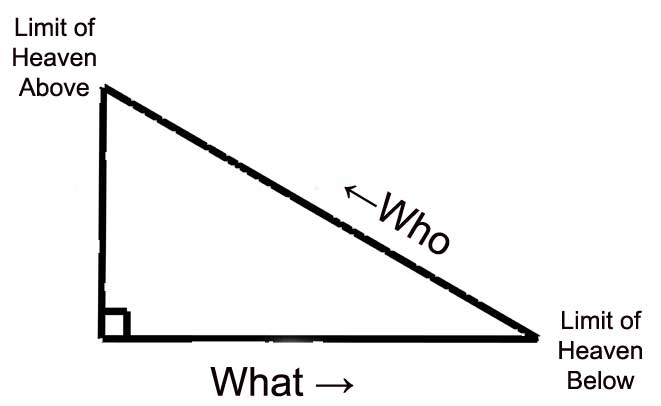
Who is End of Heaven above; What is End of Heaven below. Jacob inherited this, running from end to end – Zohar 1:1b
So the word “What” is the End of Heaven below. Thus the “limits” of Heaven are now set. Who is the limit of Heaven above. What is the limit of Heaven below. We’ve looked at this word “who.” But what of the “What?” What significance does it hold here? What about “what?” (Yes, it is starting to sound like the famous old Abbott & Costello routine – Who’s on First?!)
“What” refers to the objects and phenomena of manifest creation – the stuff that surrounds us each waking hour of our lives.
So, to sum up, the word “who” is the direction we need to look in to find the limit of Heaven above, and the word “what” describes the physical world as it is, yet seen and understood as being divine.
And so we come to Immanuel Kant – the philosopher, a native of Königsberg, Germany. Kant has been undergoing something of a revival of late, with an assortment of today’s philosophical types singing his praises on their YouTube channels. Kant’s most famous insight was that of his noumena and phenomena.
Phenomena were the manifest world – the “what” of the Zohar – the things that we see around us. Noumena were the inaccessible source of these things – unknowable to us. Kant maintained that what we experience in our lives is not “real” in a deep sense of the word. Rather it is the result of an interaction between our mind and noumena – an interaction that is forever inaccessible to us.
Given Kant’s pre-eminence in philosophy, and the finality of his statement here, he succeeded in instilling in the mind of the modern philosopher a sense of epistemological despair. No matter how hard one tried, one wasn’t getting to know reality. Perhaps one might think that this sense of a barrier is in some way good for the philosopher, keeping him grounded. But that regardless, it is I think something of a shame that Kant hadn’t read the Zohar. For his phenomena are clearly the “what” of Kabbalah. And his noumena are the “who.” He travelled far enough along the path to grasp the heavenly and immaterial nature of reality, but then could find no further way onward.
Kant, for all his amazing philosophizing, ended up making our “who” into another “what” – a collection of ideas and vague notions about who we actually are, this apparent person looking out from behind our eyes. Had he started to investigate this narrative sense of self, he would have experienced it unravelling and his journey up the ladder of Heaven, from “what” toward “who,” would have continued. But he made it to the first rung of the part of the ladder that was inside Heaven… and stopped. To travel further, he would have needed to be willing to leave the narrative self and its objective world behind. He would have to have accepted that continuing along the path would be deeply personal. Philosophy is too dry and too impersonal a tool for that journey. And because of that he inadvertently condemned those who would follow him to a similar wasteland.
And now we come to the Cybernetic Culture Research Unit (CCRU). This group of wayward British academics, formed in the nineties by Nick Land and Sadie Plant, blended continental philosophy, underground music, occult and numerological concepts and cybernetics, creating their own special mix of futuristic weirdness. It too is undergoing something of a revival these days, as global capitalism and the emergence of AI bring us into a new phase, one that many think the CCRU either predicted or are instantiating into being.
In the work of the CCRU, Kant’s noumena were brought closer to human conception with their notion of The Outside – a realm of Lovecraftian horrors and numerological demons. In so doing, perhaps inadvertently, they brought people into contact with one stratum of mental activity repressed out of awareness by our fixed, Kantian concept of self – a layer that must be faced on the upward path.
Furthermore, they maintained that two fundamental agencies were using the human realm as a battleground to wage a war for the future. One was the Architectonic Order of the Eschaton (AOE) and other the Neolemurians (NL). The first had a fixed sense of time and a reverence for order and centralised, hierarchical control systems. The latter promulgated themselves through decentralised networks, irrationality and chaos. They describe their war on the AOE as a Time War.
Whatever one thinks about these ideas, the Neolemurian’s “time war” is perhaps now coming towards us in the shape of AI. Large Language Models (LLMs), progressively speed up the rate that we can access information and simultaneously are able to predict what we will think next (the LLM is a next token predictor, vastly scaled). As they continue to improve, they may thus start to force us to reevaluate our concept of linear time – of there existing an ordered past and a predictable future, delineated by the ticking of the clock.
This Neolemurian Time War, if it arrives, will act as a wrecking ball for the Kantian model of self – the “who” as a “what” – the set of narratives about who we are, what has happened to us and what we wish to happen in the future. It will become progressively unsustainable for the average person to cling to this Kantian, AOE-constructed notion of who they are any longer. Some form of cathartic release – either salvific or destructive – will inevitably be invoked.
One result of this could be a whole new generation of people, liberated from the yoke of linear time and narrative selfhood, now free to travel up the Kabbalistic ladder toward the End of Heaven above.